
The American dream, a term first used by a Depression-era historian named James Truslow Adams, is all about upward mobility. Any US citizen, if they work hard, should be able to not only succeed, but rise above the station of their parents.
In The Epic of America, published in 1931, Adams acknowledged that the ongoing economic crisis threatened a dream that, for most people through the country’s history, seemed attainable. But he also ended on a note of optimism — quoting a Russian immigrant called Mary Antin, who credited the country’s public library system with elevating her from being a child who knew no English to a writer who published her first book as a teenager. As Antin herself put it, “mine is the shining future”.
But things have changed in America, as New York Times writer David Leonhardt lays out in his important new book. For the last half century, US incomes have stagnated and wealth inequality grown. A typical family in 2019 had a net worth slightly lower than the typical family in 2001. “There has not been such a long period of wealth stagnation since the Great Depression,” Leonhart writes. What’s more, life expectancy is down — a rare and disturbing anomaly for a rich nation — as is social mobility.
He calls this the Great American Stagnation, and for many it has turned the American dream into a myth that is impossible to imagine ever coming true. The Harvard academic Raj Chetty, whom Leonhardt helped popularise, found that while 92 per cent of children born in 1940 had higher household incomes than their parents, babies born in 1980 had only a 50/50 chance of doing better than the previous generation. This decline has come with massive economic, political and social costs, not just for the US, but for the world — everything from less willingness to engage with global crises such as climate change, to “an alarming anti-democratic movement” in the US, to a rise in racism and xenophobia.
There is no longer a mass movement focused on improving economic outcomes for most Americans
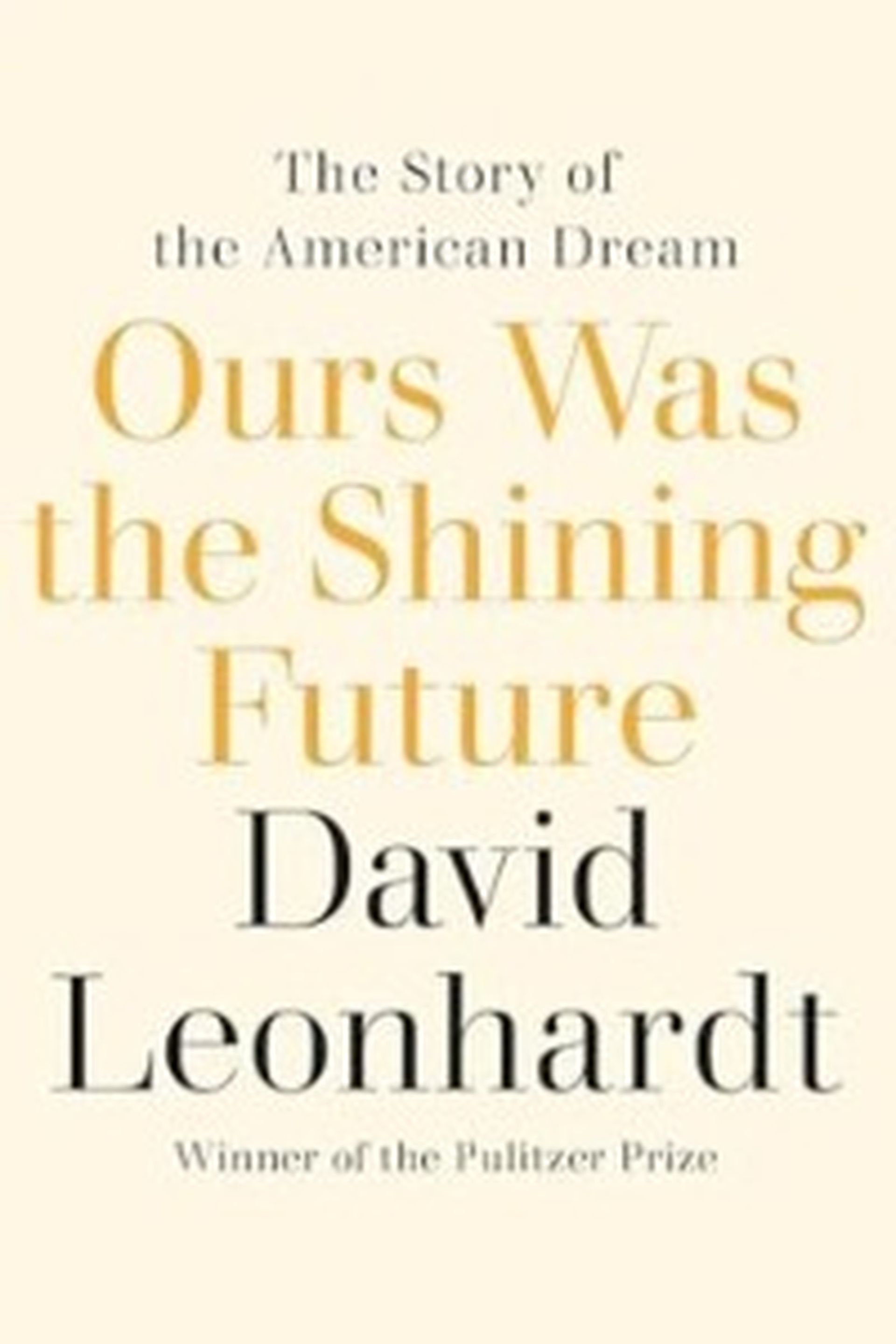
Ours Was the Shining Future, Leonhardt’s first book, is an attempt to explain what happened. His take, which I believe is correct, is that democratic capitalism (defined as “a system in which the government recognises its crucial role in guiding the economy”) has since the 1970s given way to a laissez-faire free-for-all in which corporations and short-termism rule. In this world, he writes, “there is no longer a mass movement focused on improving economic outcomes for most Americans. The country’s largest activist groups, on both the left and the right, are focused on other subjects.”
How did we get here? In Leonhardt’s analysis, changes to three things — political power, culture and investment — mean that average, working Americans have been left behind. Since the late 1960s, the “old labor” of the New Deal has been hijacked by a new and more entitled “Brahmin left”, increasingly made up of college-educated elites that talk down to workers rather than with them. In a country that fundamentally skews more socially conservative, the Democratic party has also become too radically progressive on social issues such as abortion, immigration and LGBTQ rights.
Because of this, they have lost the electoral votes needed to push through badly needed economic policies such as long-term public investment, as well as more progressive taxation, plus healthcare and educational reform, that would temper rising inequality. Add in a “greed is good” culture of self-interest and global market forces pushing only what’s good for the quarter, and you get a country in decline.
Leonhardt is at his best when he is doing the sort of data-driven analysis of economic and political trends that you might find on a newspaper opinion page. Storytelling is always harder, and authors of ideas books like this one often struggle to find the single personality-driven narrative that can weave together big trends in a way that keeps the reader moving forward. That’s what the truly great non-fiction books manage to do. I’m thinking of something such as David Halberstam’s The Best and the Brightest, which followed defence secretary Robert McNamara and his “whiz kid” group of policy experts to explain how America lost itself in Vietnam. Ours Was the Shining Future is not that book.
This is not to say that Leonhart fails. Rather than focusing on a single narrative, he tries to isolate the key events that drove the rise and fall of the American dream over 100 years in 10 chapters, many of which could have themselves been standalone book topics. He covers everything from the rise and fall of the industrial labour movement, to the history of progressivism, to the intersection of crime and political turmoil, and of course, the Reagan/Thatcher revolution and all it wrought.
The history of redlining and the institutionalisation of economic racism in the US is fascinating, as is the rise of students and women as bourgeois political forces on the left — African American women, for example, never struggled with the “feminine mystique”, as the writer Betty Friedan dubbed the malaise experienced by some middle-class housewives in the 1960s. They always had to deal with having both kids and jobs.
Much of Leonhardt’s recounting of the Reagan-Thatcher revolution and the rise of big business is predicable. That said, I was surprised and happy to learn that then senator Joe Biden was one of those who in the 1980s questioned the ascent of federal judge Robert Bork, whose rollback of traditional American monopoly policies led to a grotesque concentration of corporate power only now being addressed by president Biden’s antitrust efforts.
What’s fascinating — and far less known — is the way in which Old Labor hastened its own decline. The powerful Teamsters Union, for example, first supported farm workers’ leader Cesar Chavez and his efforts to build a more inclusive labour movement in the 1960s, before deciding to seize power for themselves in a way that only hastened the decline of the industrial labour movement as a whole. The continued fragmentation of the American labour movement has made it harder for unions to increase membership today, even as more and more people claim to support them.
It’s also interesting to see how much the tragic murders of pivotal figures such as Martin Luther King and Robert F Kennedy, both of whom were able to speak across class and colour lines, made it significantly more difficult to create a liberal coalition that would support all working people. Both King and Kennedy had worked to build a broader based coalition of voters who could counter southern racism, trickle-down economics, and a neoliberal fear (on both sides of the political aisle) of any kind of government intervention to guide the invisible hand to a more just outcome.
Their deaths, and the subsequent fragmentation of the New Left into more and more finely divided interest groups, show that the talent of individual leaders can matter as much as demographics when building political power.
Biden, who keeps a bust of Caesar Chavez in his office and has no fear of industrial policy or wealth redistribution, has tried to rebuild the power of working people. But while the US economy is now doing better than it has in a quarter century by many metrics, the polls don’t yet reflect that reality.
Ours Was the Shining Future ends before Bidenomics begins, although a concluding chapter supports many of the ideas that the White House has since advocated. But the US is still a democracy, and next year, there will be a presidential election. Whether America’s future will again shine may hinge on the outcome.
Ours Was the Shining Future: The Rise and Fall of the American Dream by David Leonhardt Riverrun £30/Random House $32, 528 pages
Rana Foroohar is the FT’s global business correspondent
Join our online book group on Facebook at FT Books Café