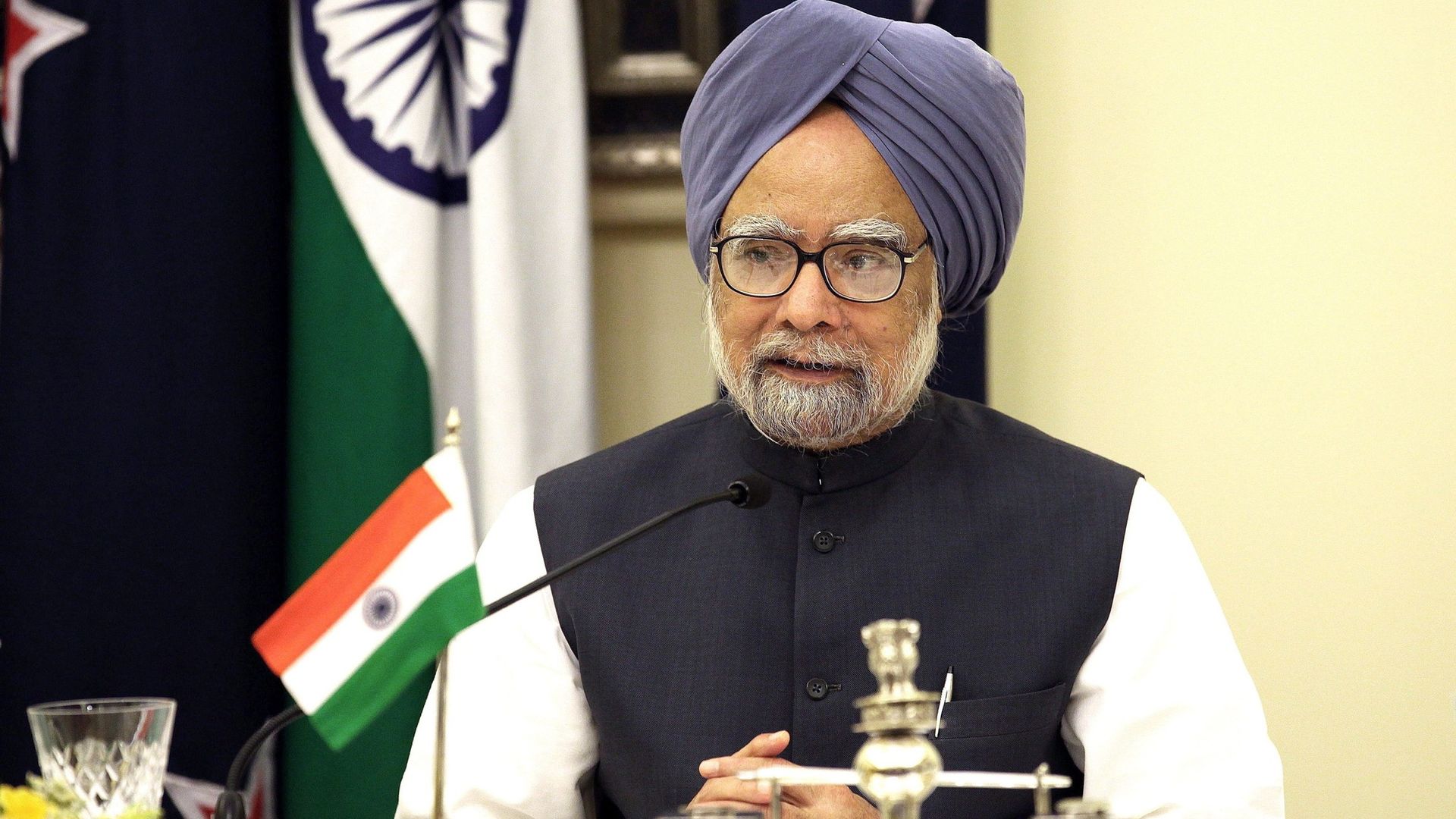
India’s former prime minister Manmohan Singh, who died aged 92 on Thursday, launched a transformative liberalisation of the state-controlled economy during a 1991 currency crisis, putting the country on a long-term trajectory of faster growth and rising global influence.
As finance minister from 1991 until 1996, Singh overcame entrenched political resistance to end decades of isolation and stagnation, open India’s doors to greater foreign trade and private investment, and begin its integration into the global economy.
The Oxford-trained economist, known for his mild, self-effacing manner and personal integrity, was subsequently tapped by Sonia Gandhi, the Italian-born Congress party leader, to serve as premier after the party’s shock electoral victory in 2004.
Singh was considered by Gandhi a safe, technocratic choice to lead India, who would not emerge as a political rival to her or her young son, Rahul, whom she was grooming to eventually take over the party leadership.
During his premiership, Singh’s hope of continuing India’s economic reforms was thwarted by Congress’s coalition partners, which objected to many of the measures he wished to pursue.
His second term in office from 2009 was seen as opportunity to press ahead with more dramatic reforms. But he ended up weak and isolated within his party as high-profile corruption scandals plagued his administration.
Born in 1932 in a rural village in what is today part of Pakistan, Singh, a member of the Sikh faith, migrated to India when British-ruled India was divided into Hindu-majority India and Muslim-majority Pakistan.
He attended university in India, then obtained a degree from Cambridge and a PhD in economics from Oxford, writing a thesis and book entitled “India’s Export Trends and Prospects for Sustained Growth”.
It challenged India’s then pervasive export pessimism that was to blight its development for a further three decades. Singh subsequently worked for several years at the United Nations Conference on Trade and Development.
In 1969, he returned to India to teach economics. Then in 1971, Singh took up a post as economic adviser in the commerce ministry, the start of a long career in government service in which he held many top posts, including governor of the Reserve Bank of India.
But his fundamental role in transforming India came in 1991, as it was facing a severe foreign exchange crisis, which had forced the country to fly some of its gold reserves abroad as security for an IMF rescue loan.
Singh seized the opportunity to break with the antitrade world view that had dominated India post-independence, and begin the process of opening up the country’s tightly controlled, socialist-oriented economy to greater private and foreign investment, bringing an end to an era of chronically low growth.
His steps, alongside prime minister P.V. Narasimha Rao, to dismantle the so-called “License Raj” of strict economic controls during his five-year tenure as finance minister laid the foundation for a rapid acceleration of India’s economic growth, hitting highs of nearly 9 per cent, up from an average of around 2 to 3 per cent.
In his first term as prime minister from 2004, Singh created debt relief and job creation schemes for farmers, and sought to establish social welfare programmes to assist those yet to benefit from India’s accelerated growth.
He also tried to bring more transparency to government by implementing a freedom of information law, similar to those in the west.
But the most significant achievement was his transformation of New Delhi’s relationship with Washington, which had imposed sanctions on India for its nuclear tests a decade earlier.
In 2008, he staked his political future on a quest to obtain parliamentary approval for a major civil nuclear agreement with the US, in spite of opposition from leftist former coalition partners and the Hindu nationalist Bharatiya Janata party.
The successful parliamentary vote buried the legacy of cold war animosity between the two countries despite India’s refusal to relinquish its nuclear weapons programme, while sealing Singh’s unlikely friendship with the then US President George W Bush.
Later that year, after Pakistan-based militants launched a seaborne terror strike on Mumbai, killing 170 people, Singh showed considerable restraint by resisting calls for harsh retaliation, thus averting a potential regional conflagration.
With the benefit of hindsight, many of Singh’s advisers said he should have handed the premiership over to a younger leader after the election victory of 2009.
His second term was one of bitter disappointment and paralysis, marred by corruption scandals, unruly allies and an economy retreating from double-digit economic growth amid stubbornly high inflation.
However, during this time, he did empower Nandan Nilekani, cofounder of tech giant Infosys, to lead a team that built an advanced biometric identification system known as Aadhaar, which gradually led to vast improvements in the delivery of welfare payments for millions of poorer Indians.
Still, public disillusionment with Singh’s seeming inaction as economic and political conditions deteriorated paved the way for the 2014 election of the BJP leader Narendra Modi, who promised muscular leadership, faster job creation and accelerated growth.
Singh kept a low profile after retirement, though he did make occasional public criticisms of his successor’s performance. In 2019 he accused Modi of creating a “toxic” environment and “climate of fear” that had led to a sharp economic slowdown by undermining business confidence.
During his final months as premier, back in 2014, Singh predicted that “history will be kinder to me than the contemporary media, or for that matter opposition parties”.