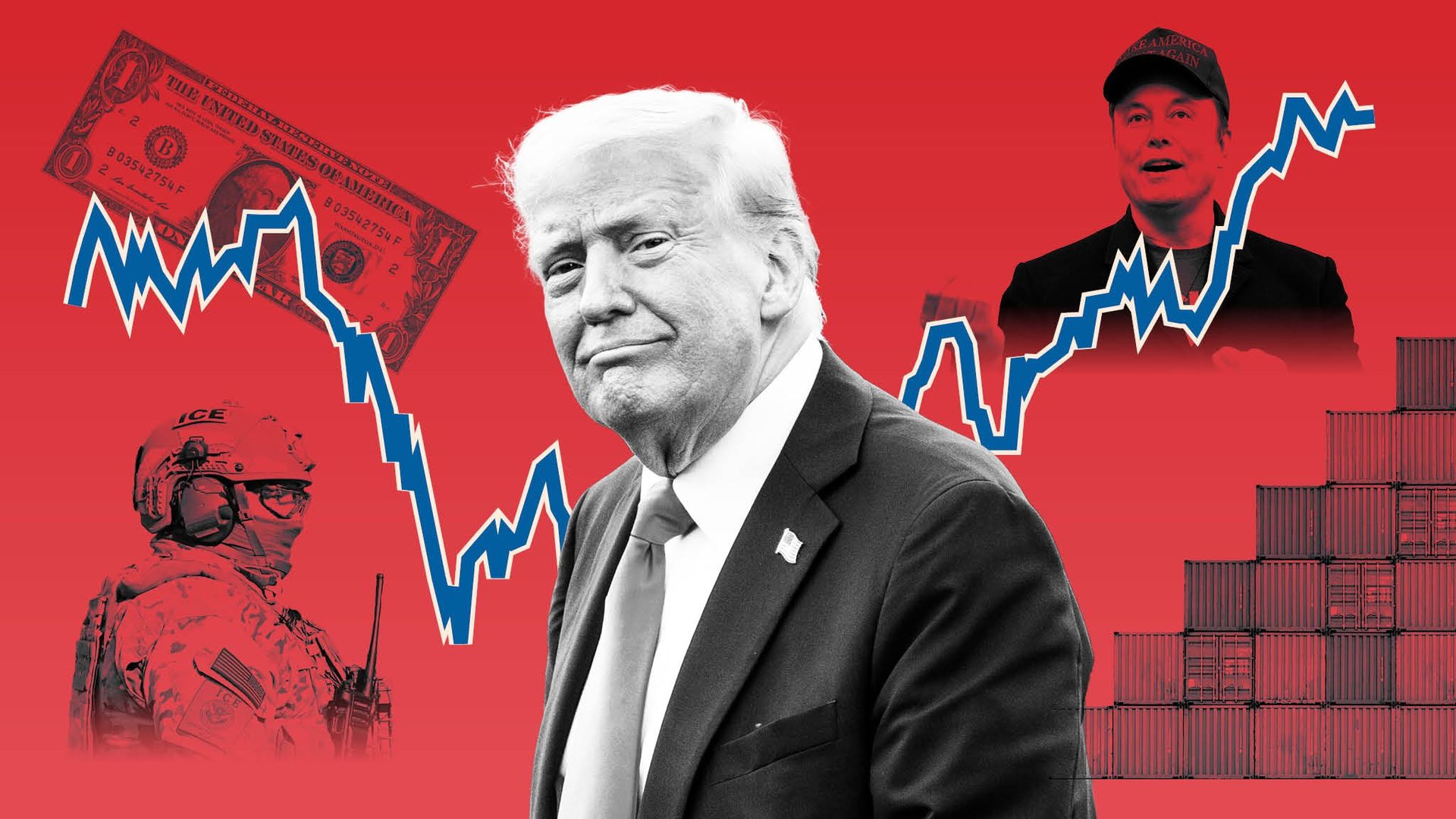
It has been six months since Donald Trump began his second term as US president.
In that time he has shaken trading relations with US allies and upended markets with tariff threats, increased immigration enforcement, imposed wide-ranging tax cuts and embarked on a project to reshape the structure of the federal government.
Many of the changes have been implemented by executive orders, bypassing congressional oversight.
Below are six charts that capture some of the tumult of the past six months.
Stocks and the dollar
In early April, US stocks registered their biggest daily decline in nearly five years after Trump announced tariffs targeting dozens of countries on what he called “liberation day”.
Since then, the markets have rebounded to all-time highs as Trump has repeatedly delayed the implementation of his tariff threats, giving rise to the viral phrase “Taco”, or Trump always chickens out.
The US dollar, meanwhile, is having its worst year since 1973, raising alarms among economists that Trump’s economic policies, coupled with his attacks on Federal Reserve independence, risk diminishing the haven role of US dollar-denominated assets for foreign investors.
Immigration
Arrests by Immigration and Customs Enforcement (ICE) have surged under Trump, who has called for mass deportations of undocumented immigrants.
The administration aims to deport 1mn people a year, and while Trump had promised to focus on those with criminal records during his 2024 election campaign, government data shows that ICE arrests are skewing heavily towards immigrants without criminal convictions.
According to the Deportation Data Project by the University of California Berkeley law school, arrests by ICE nearly doubled year on year in the month after Trump was inaugurated.
In June, there were more than 1,400 daily arrests on multiple days, while over the same period last year, during former president Joe Biden’s tenure, the number never breached 500.
Tariffs
Trump’s on-again, off-again tariff threats have driven up the overall effective US tariff rate — which measures the revenue raised by duties on goods as a proportion of import value — from 2 per cent at the start of the year to 8.8 per cent, according to tracking by the Financial Times.
Thus far these tariffs have raised $47bn more revenue than the same period last year, and reached a record-high $64bn in the second quarter. The bulk of this is from Washington’s 30 per cent levy on Chinese imports.
If all of Trump’s policies announced by July 13 are implemented, including 30 per cent tariffs on the EU and Mexico, the average effective tariff rate for US consumers could rise as high as 20.6 per cent — the highest since 1910, according to estimates by Yale’s Budget Lab.
Executive orders
From January 20 to the end of mid-July, Trump issued 170 executive orders, which allow him to act without congressional oversight, an average of about one per day and a pace that far exceeds any other recent president.
The orders define many of Trump’s signature policies: the “liberation day” tariffs, challenges to constitutionally guaranteed birthright citizenship, targeting law firms and challenging the authority of the judicial system.
‘Big, beautiful bill’
A central goal for Trump in his second term was getting Congress to pass his flagship tax and spending legislation, the so-called One Big Beautiful Bill Act. The bill passed the Senate and House by narrow, largely party-line votes, and Trump signed it into law on July 4 as military planes flew overhead.
The legislation extends vast, regressive tax cuts, paid for in part by large cuts to Medicaid, the health insurance programme for low-income and disabled Americans. Nearly 11mn more Americans will be without health insurance by 2034 as a result of the law, according to Congressional Budget Office estimates.
The bill also allocates about $170bn for immigration enforcement and border security, including $45bn to increase ICE’s detention capacity and $30bn to hire thousands of new personnel.
Cutting the federal government
The administration’s drive to reduce the size of the federal government was led by the so-called Department of Government Efficiency, or Doge, spearheaded by Elon Musk, ostensibly to root out “waste, fraud and abuse”.
The drive has led to entire departments being closed, sometimes with little consideration for the consequences. In February Musk posted to X that Doge “spent the weekend feeding USAID into the wood chipper”, referring to the agency responsible for administering foreign aid. A recent paper in the medical journal The Lancet found that ongoing deep funding cuts could result in more than 14mn additional deaths by 2030, including 4.5mn deaths of young children.
Doge has dismantled the Consumer Financial Protection Bureau and the broadcaster Voice of America, and slashed thousands of roles at the Centers for Disease Control and Prevention, Food and Drug Administration and National Institutes of Health.
Since January, it has fired more than 67,000 federal employees across a variety of agencies, according to Roger Lee, who tracks lay-offs across the federal government and tech industry.
The federal government is leading all US sectors in lay-offs, according to outplacement firm Challenger, Gray & Christmas.
Musk announced his departure from Doge in late May, but the cuts are continuing. On Monday, the US Supreme Court ruled the Trump administration could implement its plan to fire 1,400 employees at the Department of Education.
“The majority is either wilfully blind to the implications of its ruling or naive, but either way the threat to our Constitution’s separation of powers is grave,” Justice Sonia Sotomayor wrote in a dissenting opinion.